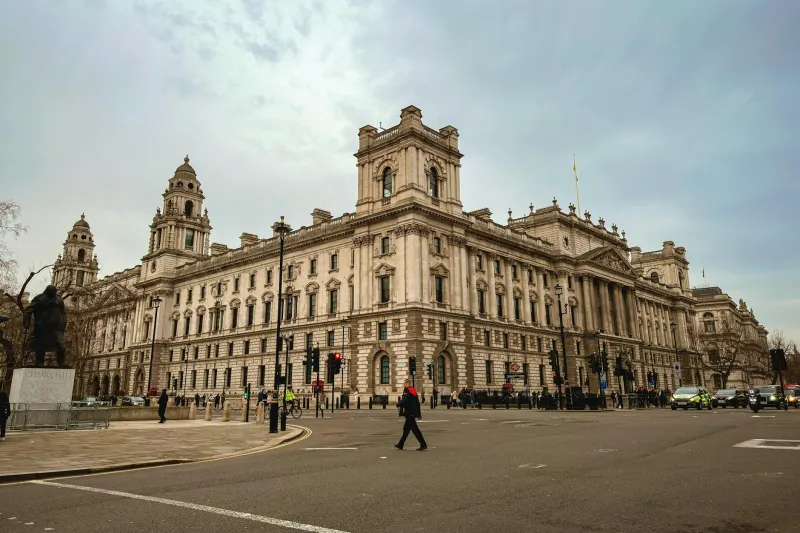
The Iron Lady's Unfinished Business
When Margaret Thatcher swept to power in 1979, she came armed with a clear mandate: roll back the state, unleash free markets, and restore British competitiveness. What she encountered was something far more insidious than Labour opposition or union militancy — a permanent bureaucratic class that viewed her agenda as an existential threat to everything they held dear.
The pattern was established early. Thatcher's attempts at genuine deregulation were met with endless position papers explaining why such reforms were "impractical" or "legally complex." Her push for privatisation faced institutional foot-dragging that turned what should have been swift asset sales into multi-year consultation exercises. Even her most trusted ministers found themselves fighting not just political opponents, but their own departments.
This wasn't incompetence. It was institutional resistance masquerading as due process.
The Cameron Capitulation
David Cameron's experience offers perhaps the clearest example of how the permanent government operates. Despite winning a surprise majority in 2015 with an explicitly conservative manifesto, Cameron's administration quickly found itself implementing policies that bore little resemblance to what voters had endorsed.
Take the promised "bonfire of the quangos." Cameron arrived pledging to slash the number of unelected public bodies draining taxpayer funds. The civil service response was masterful: they simply reclassified quangos as "arm's length bodies" or merged smaller ones into larger entities. The bureaucratic headcount barely shifted, but ministers could claim technical compliance with their manifesto commitment.
On immigration, Cameron's pledge to reduce net migration to the "tens of thousands" was systematically undermined by Home Office officials who found creative interpretations of EU law that made enforcement "impossible." When ministers pushed back, they were presented with legal advice so cautious it effectively vetoed any meaningful action.
The civil service had learned that direct confrontation was unnecessary. Strategic incompetence and selective interpretation of legal obligations could achieve the same result with far less political risk.
The May Malaise
Theresa May's tenure demonstrated how institutional capture operates even when a Prime Minister comes from the very department they're supposed to control. Despite six years as Home Secretary, May found herself repeatedly outmanoeuvred by officials who had spent decades perfecting the art of bureaucratic obstruction.
Her attempt to create a genuinely hostile environment for illegal immigration was systematically watered down by officials who briefed against their own policies to sympathetic journalists. When the Windrush scandal broke, it was notable how quickly civil servants distanced themselves from policies they had been responsible for implementing.
Brexit offered the ultimate test case. May's department heads, almost without exception, had spent their careers embedded in EU institutions and processes. Their "advice" consistently steered towards outcomes that would minimise disruption to existing arrangements — which is to say, outcomes that would preserve as much of the EU relationship as possible.
The result was a withdrawal agreement that satisfied neither Leavers nor Remainers, but perfectly served the institutional preference for continuity over democratic mandates.
Johnson's Pyrrhic Victory
Boris Johnson's overwhelming electoral victory in 2019 should have provided the political capital necessary to overcome institutional resistance. His 80-seat majority represented the clearest conservative mandate since Thatcher's heyday. Yet even Johnson found himself repeatedly frustrated by a permanent bureaucracy that had grown more sophisticated in its resistance techniques.
Dominic Cummings' attempts to reform Whitehall were met with a coordinated campaign of leaks and briefings that painted any change as dangerous populism. The media, fed by carefully cultivated civil service sources, dutifully reported that reform efforts were "chaotic" and "divisive."
When Johnson attempted to move civil servants who were openly hostile to his agenda, he was warned about "constitutional conventions" and "proper process." The same officials who had spent years slow-walking Conservative policies suddenly discovered an urgent need for procedural correctness.
The COVID response revealed the full extent of institutional capture. Scientific advisers with clear ideological preferences were allowed to drive policy while elected ministers were reduced to rubber-stamping decisions made in committee rooms they weren't invited to enter.
The Accountability Vacuum
What makes this pattern so pernicious is the complete absence of meaningful accountability. Private sector executives who consistently failed to deliver would be replaced. Civil servants who undermine government policy face no such consequences.
Sir Humphrey Appleby was funny because he was recognisable. The reality is less amusing: a permanent class of officials who view elected politicians as temporary inconveniences to be managed rather than democratic representatives to be served.
The standard defence — that civil servants provide valuable continuity and expertise — collapses under examination. Continuity in failure is not a virtue. Expertise that consistently produces outcomes opposed to democratic mandates is not neutral advice; it's institutional sabotage.
The Reform Imperative
Real change requires acknowledging that the problem is structural, not personal. Individual civil servants may be well-intentioned, but they operate within a system that rewards conformity and punishes innovation. Performance is measured by process compliance, not outcome delivery.
Successful reform would require three fundamental changes: genuine political appointments at senior levels, performance-related pay linked to ministerial objectives, and regular rotation between departments to prevent the formation of policy fiefdoms.
The alternative is to accept that Conservative governments will continue to win elections only to discover they cannot actually govern.
The Democratic Deficit
This isn't about partisan politics; it's about democratic governance. When permanent officials can systematically frustrate the policies that voters explicitly endorsed, the entire system of representative democracy is undermined.
The civil service's institutional preferences — for higher spending, greater regulation, and closer European integration — may be sincerely held, but they are not democratically legitimated. When these preferences consistently override electoral mandates, we have government by bureaucracy, not government by consent.
Without root-and-branch reform of Whitehall, the next Conservative government will face the same institutional resistance that has frustrated every right-of-centre administration since 1979. The blob always wins because it never faces consequences for failure — and until that changes, British democracy will remain a carefully managed illusion.