The Sovereign Wealth Fund Mirage: Why Keir Starmer's Great British Energy Vanity Project Is Just Nationalisation in a Hard Hat

The Sovereign Wealth Fund Mirage: Why Keir Starmer's Great British Energy Vanity Project Is Just Nationalisation in a Hard Hat
Great British Energy arrived with all the fanfare of a sovereign wealth fund that would transform Britain's energy landscape, drive down household bills, and create thousands of green jobs. Six months after its launch, the reality looks rather different. What Labour sold as a bold state investment vehicle increasingly resembles an expensive exercise in political theatre — nationalisation rebranded for an electorate that rejected the real thing.
The government's flagship energy company, capitalised with £8.3 billion over five years, has been presented as a game-changing intervention in energy markets. But examination of the Great British Energy Act 2024 and the company's actual powers reveals something far more modest: a state-owned investment vehicle with no generating capacity, no retail operation, and no clear route to reducing consumer bills.
The Promise Versus the Reality
Ed Miliband's rhetoric about GBE has been characteristically grandiose. The Energy Secretary has claimed the company will 'cut bills for good', 'create hundreds of thousands of jobs', and establish Britain as a 'clean energy superpower'. The Department for Energy Security and Net Zero's impact assessment suggests GBE could deliver £93 billion in economic benefits by 2050.
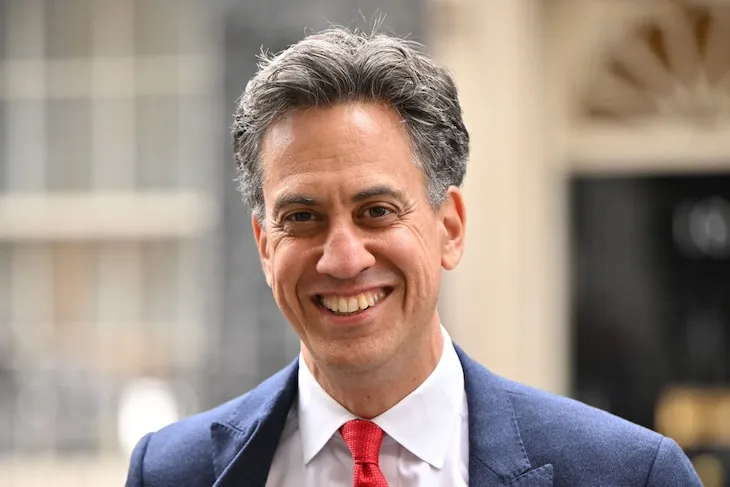 Photo: Ed Miliband, via www.spectator.com.au
Yet the company's actual statutory objectives, as defined in the Act, are remarkably vague. GBE is empowered to 'facilitate, encourage and participate in the production, distribution, storage and supply of clean energy'. It can invest in projects, enter joint ventures, and provide loans — but so can existing government departments and agencies.
The crucial limitation is that GBE cannot own or operate energy infrastructure directly. Unlike genuine state energy companies in Norway or France, Great British Energy is essentially a glorified investment fund that will take minority stakes in projects developed and operated by private companies.
Industrial Strategy's Dismal Record
The broader economic case for state intervention in energy markets rests on the assumption that government can pick winners more effectively than private investors. Britain's track record suggests otherwise. The Advanced Gas-Cooled Reactor programme cost £20 billion and delivered electricity at twice the price of coal. The renewable energy subsidy schemes of the 2000s created a boom-bust cycle that left taxpayers liable for billions in ongoing payments.
More recently, the Contracts for Difference scheme has guaranteed above-market prices for offshore wind developers while promising consumers that bills would fall. Instead, the latest CfD auction round cleared at strike prices 70% higher than previous rounds, locking in higher costs for decades.
GBE's investment strategy appears to repeat these mistakes on a larger scale. The company's business plan, published in October 2024, commits to investing in 'early-stage technologies' and 'high-risk, high-reward projects' that private investors have rejected. This is precisely the territory where state intervention has the worst track record.
The Governance Black Hole
Perhaps the most troubling aspect of Great British Energy is its governance structure. The company is wholly owned by the Secretary of State for Energy Security and Net Zero, with directors appointed by ministers and no independent oversight beyond standard company law requirements.
This creates obvious conflicts of interest when GBE investments align with government policy objectives rather than commercial logic. The company's investment decisions will inevitably be influenced by political considerations — the need to announce projects before elections, to support favoured technologies, or to direct spending toward marginal constituencies.
Parliamentary scrutiny is minimal. While GBE must submit annual reports to Parliament, there is no requirement for advance approval of investment decisions or ongoing monitoring of returns. The Public Accounts Committee can examine the company's performance after the fact, but cannot prevent poor investments from proceeding.
The Crowding Out Effect
Economic theory predicts that state investment in competitive markets will crowd out more efficient private investment. There is already evidence this is happening in Britain's energy sector. Several renewable energy developers have delayed or cancelled projects pending clarity on GBE's investment priorities, unwilling to compete with a state-backed entity that doesn't require commercial returns.
The Crown Estate's offshore wind leasing process has been similarly distorted. Developers now factor potential GBE participation into their bidding strategies, creating artificial demand for sites that might otherwise be developed more efficiently by private companies.
 Photo: Crown Estate, via www.datocms-assets.com
This crowding out effect extends beyond direct investment. GBE's £8.3 billion capitalisation represents public borrowing that could have been used to reduce the deficit, cut taxes, or invest in infrastructure with clearer economic returns. The opportunity cost of tying up this capital in speculative energy investments is substantial.
The Political Economy of State Ownership
Great British Energy's real purpose becomes clearer when viewed through the lens of political economy rather than energy policy. The company allows Labour to claim it is 'taking back control' of energy markets without the unpopular and expensive process of full nationalisation.
This explains why GBE's headquarters were located in Aberdeen rather than London — a decision that makes no commercial sense but signals commitment to Scotland's energy workers. It explains the emphasis on 'good jobs' and 'fair work' in the company's objectives, language that has nothing to do with energy production and everything to do with trade union politics.
The company also provides a vehicle for directing public investment toward Labour-supporting constituencies and interest groups. The Scottish Government's enthusiasm for GBE reflects expectations that much of the investment will flow north of the border, regardless of commercial merit.
The Conservative Alternative
A genuinely conservative approach to energy policy would focus on removing barriers to private investment rather than creating new state entities. This means streamlining planning processes, reducing regulatory uncertainty, and allowing market prices to drive investment decisions.
The most effective way to reduce energy bills is to increase supply through competition, not to subsidise politically favoured technologies through state investment. Countries with the lowest electricity prices typically have the most competitive energy markets, not the largest state energy companies.
Great British Energy represents everything that is wrong with Labour's approach to economic policy: the belief that state intervention can improve on market outcomes, the preference for political control over economic efficiency, and the assumption that taxpayers should bear the risks of speculative investments.
The company's £8.3 billion budget could have funded a 4p reduction in corporation tax, eliminated business rates for small companies, or provided substantial tax relief for working families. Instead, it will be gambled on energy projects that private investors have already rejected — a sovereign wealth fund mirage that will deliver political theatre rather than economic returns.